
Home › Massachusetts › Reading
Window Replacement, Siding, Doors and Decks in Reading, MA
Reading asks for an electrical permit application before it will issue a siding permit, wants the window order uploaded with a replacement-window permit, and checks West Street exteriors against design guidelines. Call (978) 788-0374 or use the form. A person reads every request and replies with what happens next.
- Free for homeowners
- Town and state exterior rules on this page
- West Street to Walkers Brook
Ask About Exterior Service in Your Area
Tell us about the house and the siding, windows, doors or deck you have in mind. A person reads it and replies with what happens next.
Please add your name, a 10-digit phone number and a valid email.
Your request didn't go through on our end. Please call (978) 788-0374 so it isn't lost.
Too many requests have come from this connection in a short time. Please call (978) 788-0374 and we'll take it from there.
We couldn't finish the spam check. Wait a moment and send it again, or call (978) 788-0374.
Exterior work in Reading
What are you replacing or building?
Siding
Vinyl, fiber cement and wood siding replaced or repaired, with the lead-safe rules older houses bring.

Window Replacement
Replacement and new-construction windows, sized and installed to the energy and egress rules your town uses.
Exterior Doors
Entry, storm, patio and sliding doors, swapped in existing openings or framed into new ones.
Decks & Porches
New decks, rebuilt porches and stairs, with the footings, setbacks and permits they usually need.
On West Street or near a brook?
(978) 788-0374Tell us where the house is and what you want to change outside, and we'll connect you with a contractor who knows Reading's permit, historic and wetland steps.
Permits
Permits for siding, windows and decks in Reading
Applying. The Building Division takes applications on OpenGov, and a final inspection needs the permit card and a Completion of Construction affidavit filed there. Applications carry the signed contract, the contractor's construction supervisor license and Home Improvement Contractor registration, workers' compensation and the estimated cost (Permitting & Application Information).
Siding, windows and doors. The same page spells out what the town wants for exterior jobs. For siding, "An electrical permit application is required to be submitted before a siding permit can be issued," and the number of squares goes in the work description. For windows, "If replacing or adding new windows the window order is required to be uploaded"; tempered glass is required at hazardous locations such as within 5 feet of a tub or shower or near a staircase, and film isn't accepted unless the Building Official approves it before installation. Roof shingles must be rated for winds of 110 mph or more. The page has no door-specific rule, so for doors the state chart below applies.
Fees. Building Permit Fees dated 8/2024 charge residential work $13 per $1,000 of construction value with a $50 minimum, $50 for a re-inspection, and double fees for work started without a permit (Building Permit Fees). Electrical permits, which a siding job brings with it, have their own schedule, also doubled for work without a permit (Electrical Permit Fees).
- Apply
- OpenGov
- Siding
- Electrical permit application first; list the number of squares
- Windows
- Upload the window order; tempered glass at hazardous locations
- Decks
- Statement that the AWC prescriptive deck guide will be followed, plus a plot plan
- Building fee
- $13 per $1,000 of construction value, $50 minimum (fees dated 8/2024)
- Work started without a permit
- Double fees
- Energy code
- Stretch Code since January 1, 2021
State rules. The state's contractor chart marks siding and window installation or replacement as needing a building permit, Home Improvement Contractor registration and at least a Window/Siding construction supervisor license; deck work and new door installations need a permit and a CSL; and a replacement door needs a permit "if an exit door or for public safety concerns." The chart is general guidance, and the building official makes the call (HIC contractor resources). On an owner-occupied home of one to four units, a contract over $1,000 must be in writing with the registration number, dates, price and payment schedule; the deposit can't exceed one-third of the price unless special-order windows or doors cost more; and you can cancel a contract signed at home until midnight of the third business day (c.142A §2). If you pull the permit yourself you may lose access to the Guaranty Fund, which can cover up to $25,000 of losses against a registered contractor (HIC homeowner resources). Check a registration on the Contractor Hub.
Energy code. Reading has used the Stretch Code since January 1, 2021 and has not adopted the Specialized Code (energy code adoption by municipality). Under the Stretch Code, alterations to existing homes follow its existing-building chapter (225 CMR 22); replacement windows have to meet the energy code's U-factor for new windows, so ask your installer for the NFRC label. A replacement double-hung window in a bedroom must still give at least 3.3 square feet of clear opening (780 CMR 51, chapter 3).
Lead and asbestos. In a home built before 1978, paid exterior work that disturbs more than 20 square feet of paint must be done by a Massachusetts-licensed lead-safe renovation contractor (MA lead-safe renovation), and the federal rule always covers window replacement, whatever the size (EPA RRP). Old cement or "transite" siding is suspect asbestos; MassDEP says it can't be broken, sanded, sawed or drilled, requires notice at least ten working days before removal, and requires a survey by a licensed asbestos inspector except when an owner does the work on their own owner-occupied single-family home (MassDEP asbestos FAQ).
Last verified November 2026. Fees, restrictions and deadlines on this page are due for re-checking by May 2027. New England Exterior Pros is a referral service. We don't install anything or file permits; the contractor does.
Historic review
Historic review of exteriors in Reading
The districts. Reading has local historic districts under its General Bylaw section 7.3: the West Street Historic District, set up in 2005, and the Summer Avenue Historic District Area. Violations can draw fines of $100, $200 and $300 (General Bylaw; Open Space and Recreation Plan 2022–2029).
What the commission reviews. The Historic District Commission's design guidelines, adopted in May 2006 and updated February 22, 2024, list windows, siding, roofing and roof decks among the items subject to review. They say "The use of aluminum, vinyl or other synthetic siding is generally discouraged," that the opening sizes of original and later doors and windows should be kept, and that deteriorated historic features should be repaired rather than replaced. Porches come up as part of the houses' character. Exempt from review: storm windows and doors, paint color, gutters and downspouts, window boxes, house numbers and mailboxes, vents, solar panels, at-grade walks and terraces, and ordinary maintenance and repair, though that exemption doesn't cover changes in material, design or size. The commission has 14 days to decide whether an application is subject to review and holds a hearing within 45 days; it issues certificates of appropriateness, non-applicability and hardship (HDC Design Guidelines).
Demolition delay. Outside the districts, General Bylaw section 7.2 applies to buildings on the town's List of Historic Structures, which draws on the National and State Registers and the town inventory rather than an age cutoff. Demolition there means pulling down, removing or razing a structure where a Demolition Permit is required, and if at least four Historical Commission members vote the structure protected, demolition can be delayed up to six months (General Bylaw). The bylaw doesn't say whether taking off a porch or ell counts, so ask the commission before planning one on a listed house. The town requires a Demolition Permit for demolition and substantial destruction of existing structures (Permitting & Application Information), and the commission's rules, revised July 20, 2022, ask for stamped drawings (Historical Commission rules).
National Register. Beyond the local districts, the Town Common and part of Woburn Street are National Register districts, and the town has nearly 100 National Register properties (Open Space and Recreation Plan). National Register listing alone doesn't bring local design review.
Decks and porches
Decks and porches in Reading
What the permit needs. Reading asks for "A statement from the applicant stating the Prescriptive Residential Wood Deck Construction Guide (PDF) will be followed" and a plot plan showing the deck, its size and setbacks, and points applicants to Conservation at 781-942-6616 (Permitting & Application Information). The town doesn't post its own footing or guard details. Massachusetts sets frost depth at 48 inches, and exterior stairs can have risers no taller than 8¼ inches and treads no shallower than 9 inches (780 CMR 51, chapter 3). Before footings are dug or augered, the excavator must notify Dig Safe (811) at least 72 hours ahead, not counting weekends and holidays (c.82 §40A).
Zoning. The zoning bylaw (April 2025 edition) counts "structures" as well as buildings toward lot coverage and defines a structure broadly, but it doesn't name decks either way. An accessory building or structure less than 10 feet from the house is treated as attached and must meet the house's dimensional limits, and accessory structures aren't allowed in a required front yard (Zoning Bylaw). Ask the Building Division how a deck or porch on your lot is measured.
Wetlands and flood zones. Swamps, wetlands and floodplains cover more than 30% of Reading, with mapped flood areas along the Ipswich River, Bear Meadow Brook and Walkers Brook (Open Space and Recreation Plan). The Conservation Division requires prior approval for work including additions, decks or patios within 100 feet of a wetland, lake or pond, within 200 feet of a river or stream, or in the 100-year floodplain (Conservation Division). The wetland regulations of December 2023 set a 25-foot Zone of Natural Vegetation, keep new structures 10 feet from it, and keep overhangs such as cantilevers, bay windows and eaves at least 7 feet from it (Wetlands Protection Regulations).
Reading's homes
Center-chimney colonials to workers' cottages
Reading's 2023 Housing Production Plan says over half of its housing units were built before 1960; 72.5% are one-unit detached houses, and the plan notes older historic homes in need of repairs and renovations (Housing Production Plan 2023). That puts most houses in town inside the pre-1978 lead rules.
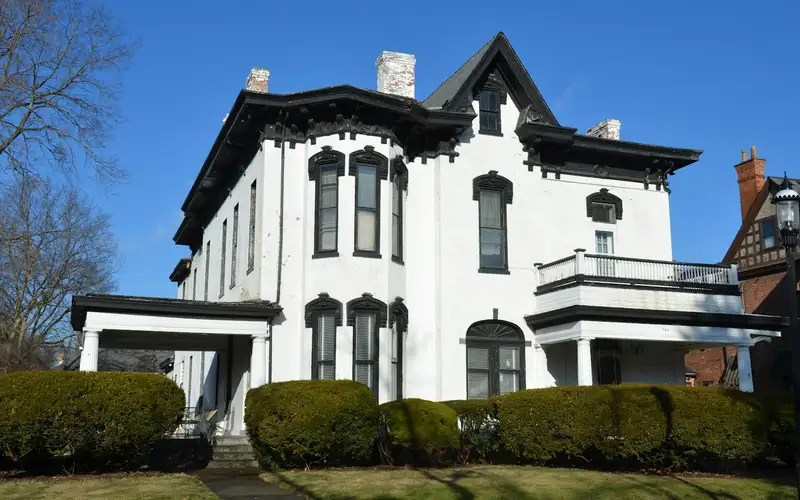
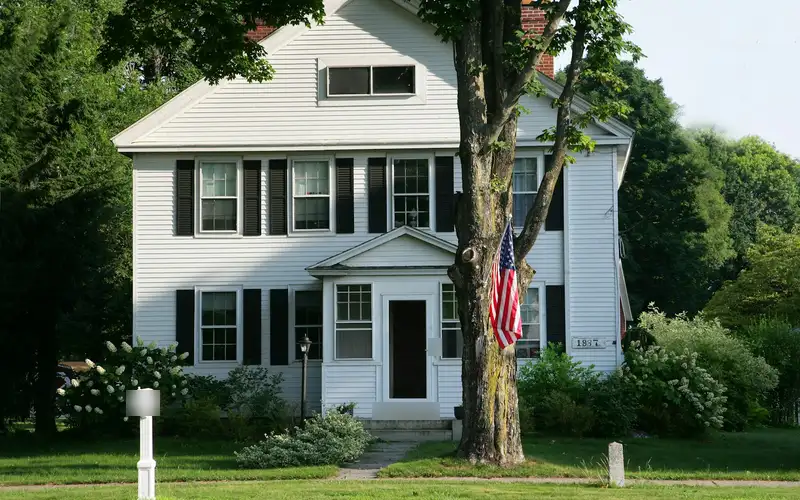
The state's 1980 survey of Reading describes center-chimney colonials from about 1735 to 1760, Greek Revival houses at the center and on Salem, Woburn and South Main Streets, Italianate houses along Woburn, Prospect and Salem Streets, and workers' cottages and double houses east of the center from 1870 to 1915 (MHC town report). On houses like these, matching trim and keeping window openings the same size matter more than on newer ones, and inside the West Street district the guidelines expect it.
FAQ
Reading exterior questions
Why does Reading want an electrical permit for a siding job?
The town's permitting page says an electrical permit application has to be submitted before a siding permit can be issued, and the siding application must list the number of squares. Meters, lights and outlets on the walls usually have to come off and go back on when siding is replaced.
What does a replacement-window permit in Reading need?
The window order has to be uploaded with the application. Tempered glass is required at hazardous locations, such as within 5 feet of a tub or shower or near a staircase, and the town says film is not acceptable unless the Building Official approves it before it goes in.
Can I put vinyl siding on a house in the West Street Historic District?
Siding is one of the items the Historic District Commission reviews, and its design guidelines, updated February 22, 2024, say aluminum, vinyl or other synthetic siding is generally discouraged. Storm windows and doors and paint color are exempt from review. Ask the commission before you order materials.
Do I need Conservation approval for a deck in Reading?
If the deck is within 100 feet of a wetland, lake or pond, within 200 feet of a river or stream, or in the 100-year floodplain, the Conservation Division asks for prior approval, and it names decks in that list. The town's wetland regulations also keep new structures 10 feet back from the 25-foot no-vegetation-removal zone.
What does it cost me to use New England Exterior Pros?
Nothing. Asking is free for homeowners; the contractor prices the job, and the price and contract are between you and them.
Nearby