
Home › Massachusetts › Lowell
Window Replacement, Siding, Doors and Decks in Lowell, MA
Lowell lets contractors file siding and window permits online, but in its historic neighborhoods, pulling off old trim or a porch to make way for new siding counts as partial demolition. Call (978) 788-0374 or use the form. A person reads every request and replies with what happens next.
- Free for homeowners
- City and state exterior rules on this page
- Belvidere to Pawtucketville
Ask About Exterior Service in Your Area
Tell us about the house and the exterior work. A person reads it and replies with what happens next.
Please add your name, a 10-digit phone number and a valid email.
Your request didn't go through on our end. Please call (978) 788-0374 so it isn't lost.
Too many requests have come from this connection in a short time. Please call (978) 788-0374 and we'll take it from there.
We couldn't finish the spam check. Wait a moment and send it again, or call (978) 788-0374.
Exterior work in Lowell
What needs replacing or building?
Siding
Vinyl, fiber cement and wood siding replaced or repaired, with the lead-safe rules older houses bring.
Window Replacement
Replacement and new-construction windows, sized and installed to the energy and egress rules your town uses.
Exterior Doors
Entry, storm, patio and sliding doors, swapped in existing openings or framed into new ones.
Decks & Porches
New decks, rebuilt porches and stairs, with the footings, setbacks and permits they usually need.
Old house, historic street?
(978) 788-0374Tell us the street and what's going on the house, and we'll connect you with a contractor who works within Lowell's Historic Board and lead-safe rules.
Permits
Permits for siding, windows and decks in Lowell
What the application covers. Lowell's residential building permit application has check boxes for "Siding," "Replacement Windows" (with the number of windows), "Deck/Porch Using Existing Foundation" and "Deck/Porch w/ Foundation." It asks for the contractor's construction supervisor license and Home Improvement Contractor registration numbers, and a workers' compensation affidavit; without the affidavit, the permit is denied (residential application).
Online or in person. Siding and window permits go through the city's Munis self-service portal, which also takes roofing, insulation, solar and trade permits. The city does not accept new construction or remodel/alteration permits online; those are filed at Development Services, 375 Merrimack Street, 2nd Floor, Room 55, 978-674-4144 (Building Permits).
Fees. As posted in November 2026, the building permit fee is $50 for construction costs up to $1,000, plus $10 per $1,000 or fraction over $1,000; a re-inspection is $50, and work started without a permit pays a triple fee (Building Permit Fees). The city's fee index says amounts follow the Fee Ordinance (Chapter 150) and are subject to change without notice.
- Where to file
- Development Services, 375 Merrimack Street, 2nd Floor
- Phone
- 978-674-4144
- Online (Munis)
- Siding, windows, roofing, insulation, solar, trade permits
- In person only
- New construction and remodel/alteration
- Fee (posted November 2026)
- $50 up to $1,000, plus $10 per $1,000 over
- Work started without a permit
- Triple fee
- Energy code
- Stretch Code since January 1, 2011; no Specialized Code
State rules for exterior contractors. On the state's contractor chart, which it calls general guidance, siding and window installation or replacement need a building permit and at least a "Window/Siding" construction supervisor license; decks, exterior stairs, structural carpentry and new door installations need a permit and a supervisor license; and a replacement door needs a permit "if an exit door or for public safety concerns" (HIC contractor resources). Contractors working on an owner-occupied home of one to four units must be registered Home Improvement Contractors (registration lookup). A contract over $1,000 must be in writing, with the registration number, start and completion dates, price and payment schedule; the deposit is capped at one-third of the price unless special-order materials such as custom windows cost more; and a contract signed at home can be cancelled until midnight of the third business day (c.142A §2). If you pull the permit yourself, you lose access to the Guaranty Fund, which can pay up to $25,000 of losses against a registered contractor (HIC homeowner resources).
Energy code. Lowell has used the Stretch Code since January 1, 2011 and has not adopted the Specialized Code (energy code adoption by municipality). Replacement windows must meet the energy code's U-factor for new windows; ask your installer for the NFRC label.
Lead paint and cement siding. The residential application includes a lead paint affidavit section, and the state rules are strict in a city this old. In a home built before 1978, paid work that disturbs more than 20 square feet of exterior paint, or replaces windows, must be done by a state-licensed Lead-Safe Renovation Contractor, with a certified supervisor on site while work is under way (MA lead-safe renovation); federal rules treat window replacement as "always covered regardless of square footage" (EPA RRP). MassDEP lists cement or "transite" siding as suspect asbestos: it may not be broken, sanded, sawed or drilled, removal must be notified at least ten working days ahead, and a survey by a DLS-licensed inspector is required unless an owner is doing the work on their own owner-occupied single-family home (MassDEP asbestos FAQ).
Last verified November 2026. Fees, restrictions and deadlines on this page are due for re-checking by November 2027. New England Exterior Pros is a referral service: we don't install anything, and the contractor you hire files the permits.
Historic review
Historic review of exteriors in Lowell
Eleven districts. The Lowell Historic Board reviews work in the Downtown Lowell Historic District and ten neighborhood districts: Acre, Andover Street, Belvidere Hill, Livingston-Harvard, Rogers Fort Hill Park, South Common, Tyler Park, Wannalancit Street, Washington Square and Wilder Street. The city's advice is to contact Board staff to see whether your planned work needs review, and its Quick Find tool looks up an address (Review Districts Permitting).
Siding and porches in the neighborhood districts. In the nine neighborhood districts other than the Acre, the Board "must approve in advance all demolition (including partial) and new construction." Partial demolition includes removing "an historic porch or architectural detailing" such as trim, moldings and brackets. The Board's guide says vinyl siding that "can be achieved without removing architectural detailing" gets no review, but stripping trim to install it does. Approval comes as a Historic Permit, sometimes with conditions, and major reviews average about 30 days (neighborhood district permitting process). The design standards define demolition as "the complete or partial tearing down of a building, or structure or the removal of a building" (Neighborhood District Design Review Standards).
The Acre is stricter. In the Acre Neighborhood District, "The erection, demolition, reconstruction, or alteration of any exterior feature" is reviewable, and the Board must approve it before work begins, even when no building permit is needed. Ordinary maintenance, in-kind replacement and easily reversible changes are handled by staff in about 7 days; other changes go to a public hearing, about 30 days (Acre permitting process). Downtown has its own permitting guide, dated November 9, 2023.
Decks and porches
Decks and porches in Lowell
What the zoning code calls a porch. Lowell's zoning ordinance (amendments through September 29, 2026) defines a porch as covered by a permanent roof and not enclosed with walls, windows or screens more than 4 feet above the platform, and a deck as a platform without a permanent roof. Roofed porches and balconies count toward gross floor area, enclosed or not; unroofed porches and balconies no higher than the second floor do not. Covered front porches "may fall within the minimum front yard setback," up to the distance the dimensional table lists for porches (Zoning Ordinance, §5.1.1 note 2). In residential districts, accessory buildings must stay at least 10 feet from the house and 5 feet from side and rear lot lines (§4.3.5).
Brooks, rivers and flood protection. The city's wetlands ordinance requires Conservation Commission permission for building within 100 feet of the bank of any perennial or intermittent stream, river, lake or pond, and covers land subject to flooding (Wetlands Ordinance). The open space plan lists flooding along the Merrimack, the Concord River, Black Brook, Clay Pit Brook and Marshall Brook, with floods in 2006 and 2007 reaching the 100-year flood elevation (Open Space and Recreation Plan 2019–2026). The Army Corps flood protection system built in 1941 after the floods of 1936 and 1938 protects the Lakeview Avenue neighborhood (Flood Protection).
Footings and stairs. The city posts no deck guide or frost depth. The state code sets frost depth at 48 inches and limits exterior stair risers to 8¼ inches with treads of at least 9 inches (780 CMR 51, chapter 3). Before footings are dug or augered, Dig Safe must be notified at least 72 hours ahead, not counting weekends and legal holidays (c.82 §40A); call 811 (Dig Safe).
Lowell's homes
Three-deckers, Victorians and mill-era brick
Lowell's housing is old even by New England standards: the Housing Production Plan 2024–2028 says 77% of homes were built before 1960, nearly a third before 1900, and only 4% after 2000 (Housing Production Plan). That makes lead-safe rules part of almost every siding or window job in the city.
Belvidere
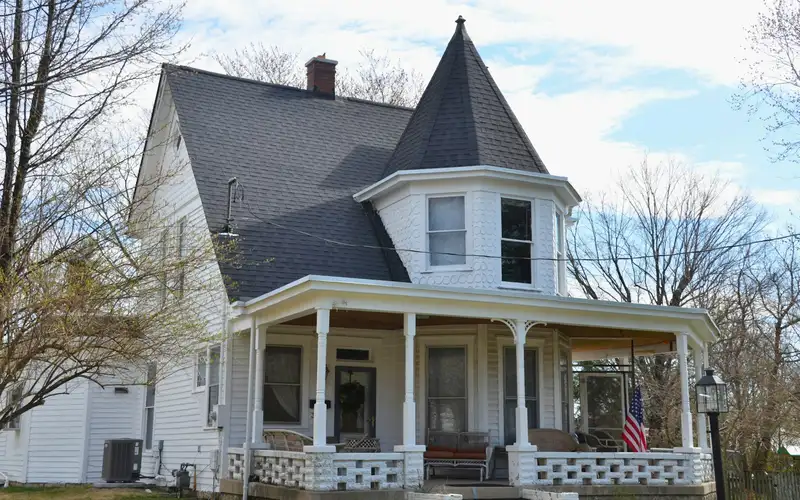
The state's 1980 survey notes elaborate Picturesque Victorian suburban houses here.
Pawtucketville
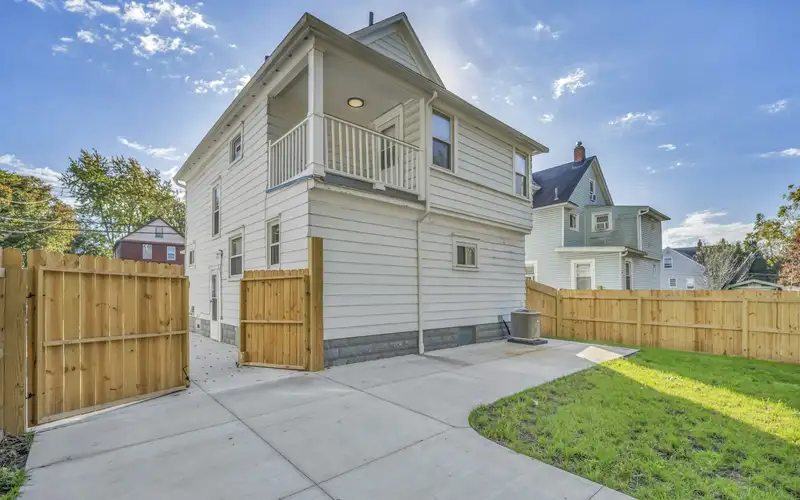
The state's 1980 survey describes dense working-class blocks and well-preserved three-decker streetscapes here.
Centralville
The 1980 survey says Centralville's low-lying areas became densely developed working-class neighborhoods.
The same MHC reconnaissance report traces three-story brick row houses built as mill boarding houses, Queen Anne houses from the 1880s to about 1905, wood-frame apartment houses from the 1890s and 1900s, and bungalows and two-deckers from 1915 to 1940. On a wood-frame Victorian or three-decker, check whether the house sits in a Historic Board district before any trim or porch comes off.
FAQ
Lowell exterior questions
Can a siding or window permit be filed online in Lowell?
Yes. The city's Munis self-service portal takes siding and window permits, along with roofing, insulation, solar and trade permits. New construction and remodel or alteration permits are not taken online; those are filed in person at Development Services, 375 Merrimack Street, 2nd Floor.
Does vinyl siding need Historic Board approval in Lowell?
In the nine neighborhood districts outside the Acre, not if the siding can go on without removing architectural detailing. Removing trim, moldings, brackets or an historic porch is partial demolition, which the Board must approve in advance. In the Acre Neighborhood District, any exterior alteration needs Board approval before work begins.
Can a covered front porch sit inside the front setback?
The zoning ordinance says covered front porches may fall within the minimum front yard setback, up to the distance listed for porches in its dimensional table. Ask Development Services for the figure that applies to your district before you plan the porch.
Do I need permission to build a deck near a brook or pond in Lowell?
Yes, if it is close. The city's wetlands ordinance requires Conservation Commission permission for work within 100 feet of the bank of a stream, river, lake or pond, and it covers land subject to flooding. It sets no fixed no-build distance, so the Commission decides case by case.
What does it cost me to use New England Exterior Pros?
Nothing. Asking is free for homeowners; the contractor prices the job, and the price and contract are between you and them.
Nearby